Start with where you want the bag to sit
Strap length affects more than appearance. It determines whether you can reach the bag easily, whether it stays in place as you walk, and where its weight rests against your body. Begin by deciding how you usually carry it: on one shoulder, across your body, or in your hand. Then put a few typical items inside. An empty bag may sit differently from one carrying your keys, phone, and other daily essentials.
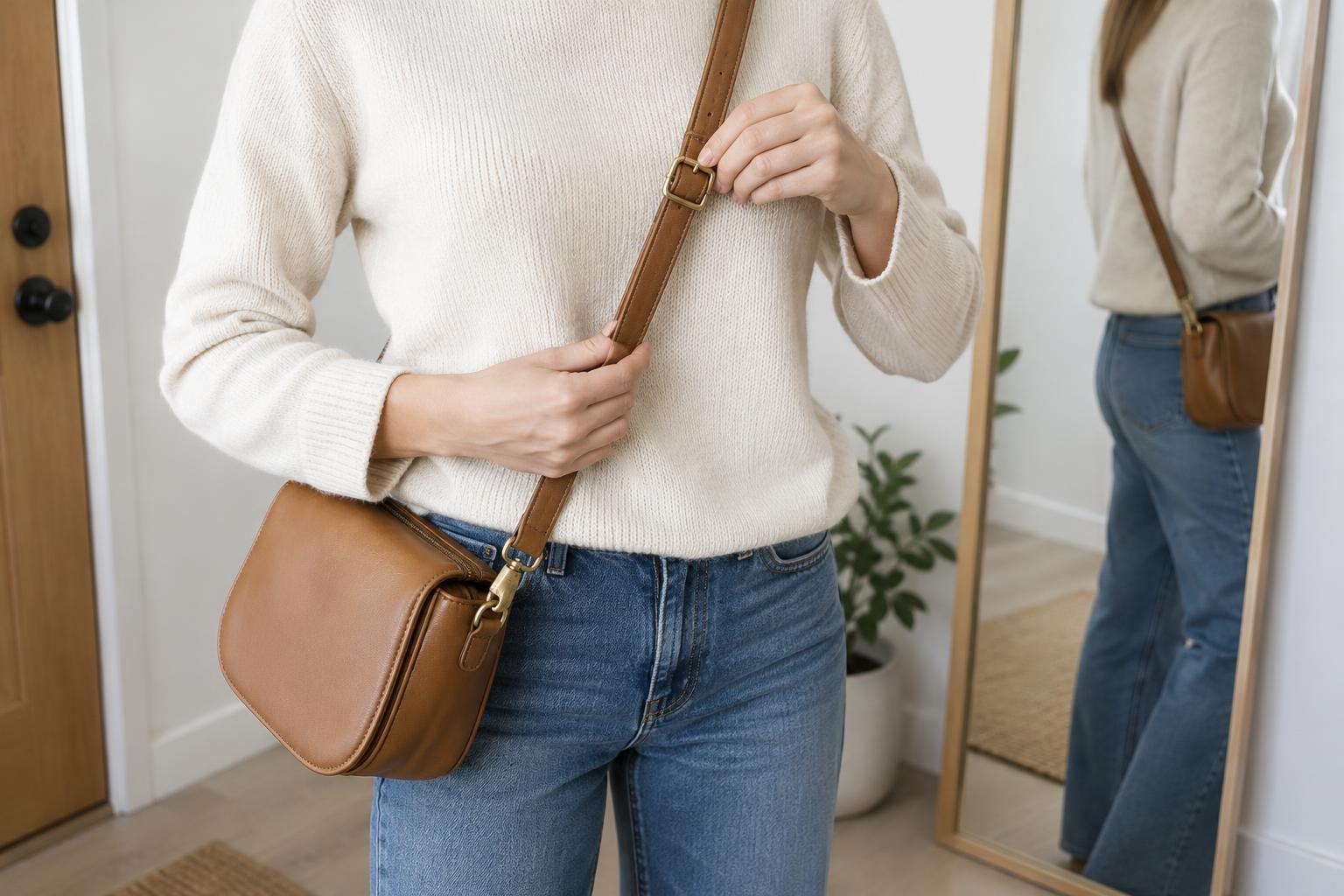
For a shoulder bag, aim for a position that lets your arm hang naturally without trapping the bag tightly beneath it. For a crossbody bag, try a length that leaves the bag accessible without letting it swing far from your body. There is no single correct height. A compact bag may feel convenient near the waist, while a larger bag may be easier to manage a little lower. The useful test is whether you can walk, sit, and open it without repeatedly shifting it.
Understand what you are adjusting
A bag’s stated strap length is not always the same as its drop: the distance from the top of the strap to the top of the bag when it hangs. Bag shape, attachment points, and the way a strap curves over your shoulder all affect the final position. If you are comparing bags, focus on how each one sits when worn rather than relying on a length alone.
Many adjustable straps use a sliding buckle. To shorten one, feed the loose section through the slider while keeping the strap flat; to lengthen it, ease more webbing or leather through. Other straps have holes and a buckle, allowing you to move one hole at a time. Some have clips and interchangeable lengths. Check that clips are fully closed and that any doubled section lies neatly before wearing the bag. If the hardware is stiff, take your time rather than pulling hard enough to strain the strap.
Test the fit while moving
Once you have adjusted the strap, try the bag on with the kind of coat or top you expect to wear. A thick layer changes the fit, and a smooth fabric may let a shoulder strap slide more easily than a textured one. Walk around, reach for something, sit down, and take the bag off and on. These simple checks reveal more than standing still in front of a mirror.
Notice whether the bag bumps against your hip, pulls at your neckline, or gets in the way when you bend or sit. If it swings too much, shortening the strap slightly may help. If it feels crowded under your arm or awkward to open, try lengthening it. For a crossbody style, check the path of the strap as well as the bag’s position: it should lie reasonably flat rather than twist or catch on a collar. Make one small adjustment at a time so you can tell what improved the fit.
Balance comfort, access, and outfit proportions
A comfortable setting should suit both the bag and its contents. A heavy bag on a narrow strap may feel less pleasant than a lighter bag in the same position. Reducing what you carry, choosing a wider strap, or occasionally changing the shoulder you use can be more useful than adjusting the length again. If a bag consistently feels awkward even when lightly packed, its shape or strap design may simply not suit the way you want to carry it.
Length also changes the look of an outfit. A shorter shoulder strap keeps the bag close to the upper body, while a longer one creates a lower line. Crossbody bags draw a diagonal across clothing, so it is worth checking where both the strap and the bag fall over a jacket, scarf, or patterned top. Let comfort lead, then fine-tune the length within the range that feels practical.
Keep your preferred setting easy to use
If you regularly switch between a light top and a bulky coat, you may want two familiar strap settings. Notice which buckle holes you use, or make a mental note of where the slider sits. After adjusting, check that the strap is not twisted and that any loose end is secured by its keeper if it has one. This prevents the end from dangling and makes the bag look tidier.
Inspect the strap and its attachment points from time to time, particularly if you carry the bag often. Look for loose stitching, worn holes, or hardware that no longer closes reliably. A well-chosen length makes everyday carrying simpler, but it works best when the strap itself is in good condition. The goal is not a perfect measurement; it is a bag that stays manageable as you move through an ordinary day.