Start with the days you need to dress for
A versatile dress is not necessarily one that works for every occasion. It is one you can reach for often without changing your plans around it. Before choosing a cut or colour, think about a typical week: how much you walk, whether you sit for long periods, what shoes you usually wear and how dressed-up you need to feel. A dress that suits those routines will earn more use than one that looks flexible on a hanger but feels awkward by midday.
It helps to name two or three outfits you could make with the dress using clothes you already own. Perhaps it works with trainers and a light jacket, then with flat boots and a cardigan. If those combinations feel natural to you, the dress has a stronger case for a place in your wardrobe. Versatility is personal: an easy-to-layer shirt dress may be useful for one person, while another will get more wear from a simple knit dress.
Choose a cut that gives you room to move
The cut affects both the appearance and the experience of wearing a dress. A straight or gently A-line shape can be easy to layer because it does not depend on a precise waist fit. A wrap-style dress allows some adjustment at the waist, though its neckline and overlap should stay in place when you move. A fitted knit dress may feel comfortable because it stretches, but check whether you enjoy how it sits when you are standing and seated.
Look beyond the shape named on the label. Notice where the shoulder seams sit, whether the armholes let you lift your arms and whether a waist seam lands comfortably on your body. Try walking, sitting and reaching for something. If you spend the fitting-room visit pulling a hem down, adjusting a neckline or smoothing fabric, you may end up doing the same throughout the day. The right cut should leave you free to get on with things.
Pick a length for your movement and shoes
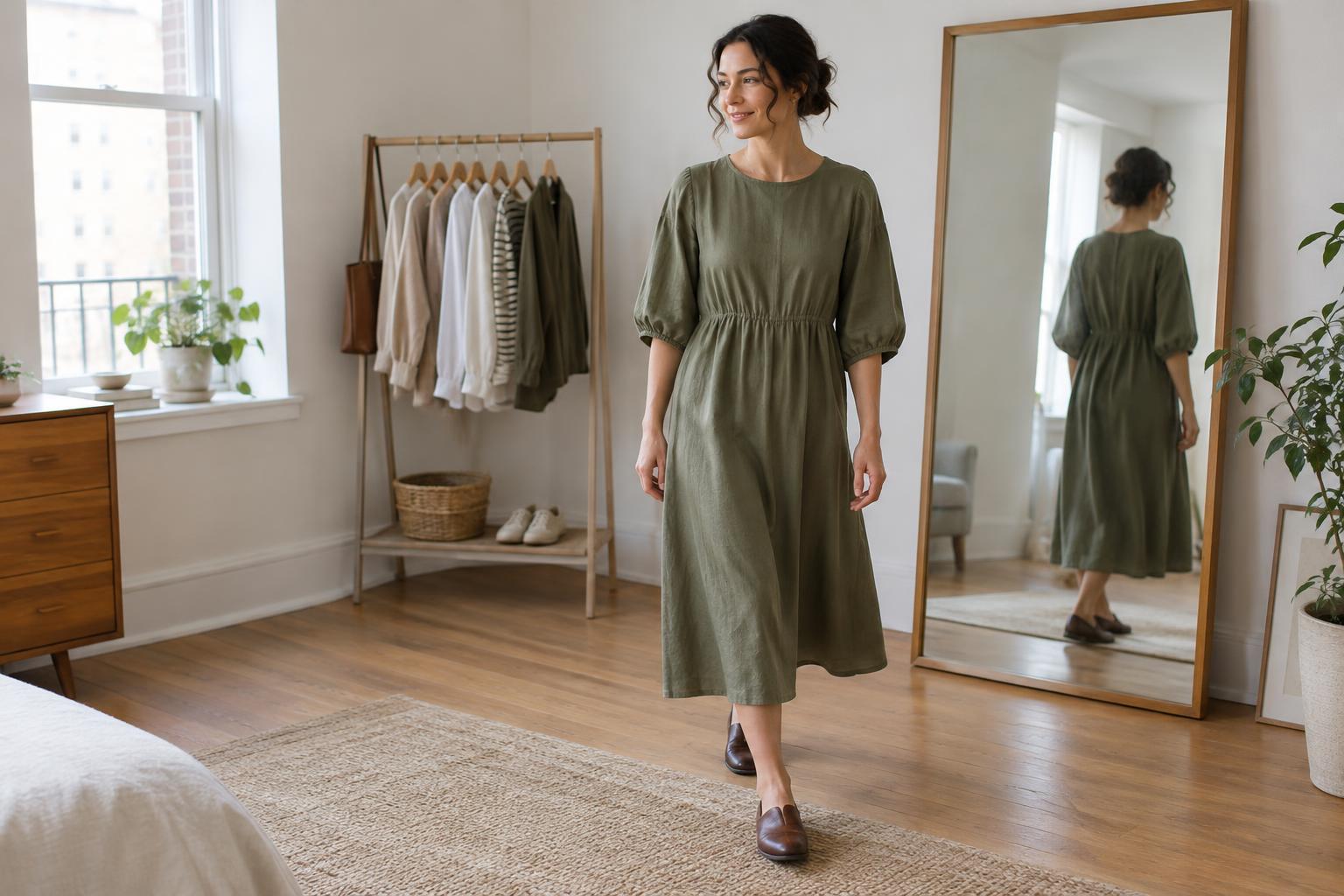
Length is easiest to judge in motion rather than in a mirror pose. A shorter hem may feel convenient with tights or on warm days, but less comfortable if you often bend or sit. A midi length offers more coverage and can work with several kinds of footwear, although the exact hem position can change how you feel in an outfit. A longer dress may suit your style while requiring a little more attention on stairs or in wet weather.
Try a dress with the shoes you expect to wear most often, or picture those shoes alongside it. Check where the hem falls when you sit and whether it catches at your knees as you walk. If a longer dress has a side opening, make sure it gives you enough stride without exposing more than you want. There is no universally useful hemline; the practical choice is the one you can wear without thinking about it all day.
Check fabric and small details for everyday comfort
Fabric can make a promising dress feel either effortless or demanding. Consider its weight, softness and how it hangs on you. A lightweight fabric may be pleasant in warmth but need a layer underneath if it feels too sheer. A heavier fabric may hold its shape well yet feel less suitable for your usual indoor temperatures. If a fabric creases, ask yourself whether you mind that look or would prefer something that needs less attention.
Details deserve the same practical test. A lining should move with the outer fabric rather than twisting or clinging. Buttons should stay closed when you sit, and a zip should be easy to use. Pockets are helpful only if you like how they sit when filled. Check the care label, too: a dress is easier to wear regularly when its cleaning needs fit your habits. None of these details has to be perfect, but repeated annoyances can outweigh an attractive design.
Make versatility a final, realistic test
Before deciding, put together a small set of outfits in your mind or at home. Can you wear the dress on its own, add a layer when it is cooler and change the mood with shoes or a scarf you already have? A colour does not need to be neutral to be useful; it simply needs to work with enough of your wardrobe that getting dressed feels easy. A familiar pattern can serve the same purpose if you enjoy wearing it.
Finally, ask whether the dress feels like something you would choose on an ordinary morning. It should meet your needs for coverage, movement and care without requiring a special occasion to justify it. If two dresses seem equally appealing, favour the one that feels comfortable for longer and pairs readily with what you own. That is often a more reliable measure of everyday versatility than how many hypothetical outfits you can imagine.