Start with where your trousers sit
A belt fits the waistband of your trousers, which may not sit at your natural waist. High-rise trousers can sit much higher than low-rise jeans, and the same belt may feel different with each pair. Before choosing a size, put on the trousers you plan to wear most often and note where their loops sit. If you want one belt for several pairs, try those trousers on too: a comfortable fit across them matters more than a size label.
The belt should hold the waistband in place without pulling it into deep folds or making sitting uncomfortable. If trousers only stay up when the belt is pulled very tight, the waistband itself may be too loose. A belt can make a small adjustment, but it cannot reliably fix a substantially poor fit.
Measure for a useful range of adjustment
If you already own a belt that fits well, lay it flat and measure from the point where the buckle pin meets the frame to the hole you use most. That measurement is more useful than the belt’s overall length, which includes the buckle and the length beyond the holes. When comparing belts, check how the seller defines its sizes; a number on a label does not always describe the same measurement.
Without a reference belt, thread a flexible measuring tape through your trouser loops while wearing the trousers. Keep it snug enough to follow the waistband, but not so tight that it changes the fit. Use that measurement as a starting point and check the belt’s hole positions before buying. Ideally, your usual fit will use a hole near the middle of the available range, leaving room to adjust for different trousers or layers.
Also look at the length left after fastening. The free end should reach a keeper or nearby loop without wrapping far around your body. This is partly a style preference, but an end that cannot be secured may stick out during the day.
Check the loops, not just the belt width
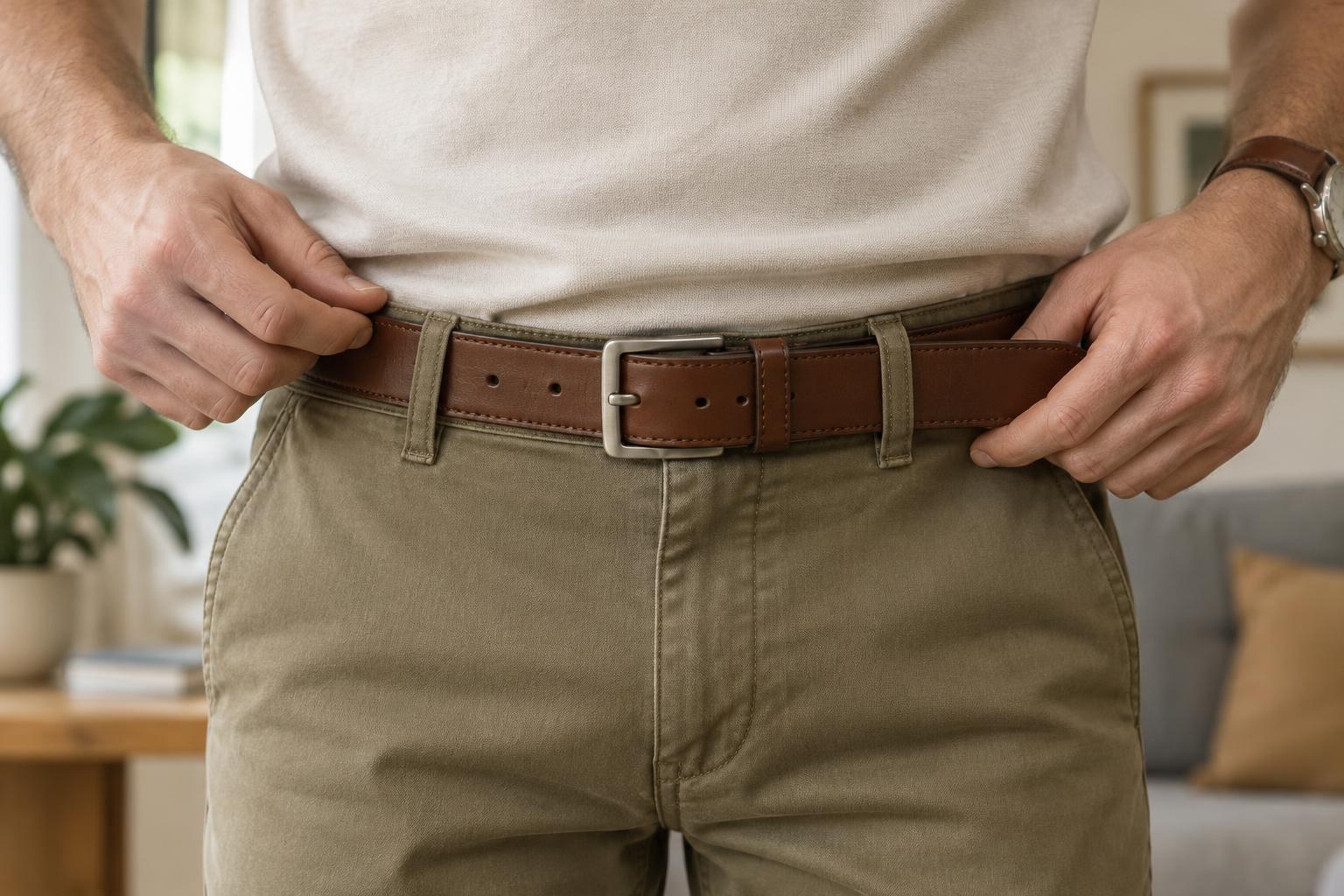
A belt needs to pass through every trouser loop without a struggle. Measure the inside height of a loop on the trousers you intend to wear, then choose a belt that is slightly narrower. Do not rely on a close-looking match: thick leather, raised stitching or a wide belt tip can make a belt harder to thread even when its stated width seems suitable.
Check the buckle as well. Its frame may be wider than the strap, and a bulky buckle can feel awkward against a short or closely spaced front loop. You generally do not need to pull the buckle through the loops, but you do need enough space to fasten it comfortably at the front. If you are buying for several pairs of trousers, use the smallest loops as your guide. A narrower belt is often easier to share across a wardrobe, though it may look less balanced with especially wide loops.
Choose a buckle and material you will enjoy wearing
A simple buckle is easy to pair with many everyday outfits, while a larger or more decorative one draws attention to the waist. Try sitting down when assessing a buckle: if it presses into your stomach or catches on clothing, its appearance may not outweigh the inconvenience. Check that the pin enters the holes cleanly and that the buckle lies reasonably flat when fastened.
Material affects how a belt feels and changes with use. A supple leather belt may become more flexible over time; a stiff one may take longer to feel comfortable. Woven or fabric belts can offer a softer look, and some allow finer adjustment than a belt with fixed holes. Whatever you choose, inspect the edges, holes and stitching. A belt that feels comfortable in your hands and works smoothly through the loops is more useful than one chosen only for its colour.
Test it with an outfit before deciding
Fasten the belt while wearing the trousers and a typical top, then stand, sit and walk. The waistband should stay in place, the buckle should remain comfortable, and the belt should not twist sharply inside the loops. Notice whether the free end stays tucked away. If you plan to wear a tucked-in shirt or short jacket, look at the belt as part of the whole outfit rather than as an isolated accessory.
For a versatile choice, consider a colour and finish that works with several pairs of trousers and shoes you already own. They do not need to match exactly; a quiet contrast can look intentional. Once you have found a belt that fits, store it without a tight bend and follow its care instructions. Good sizing, comfortable hardware and a width that suits your loops will do more for everyday wear than any strict styling rule.