Start with the job you want the T-shirt to do
Before comparing labels or colours, decide how you expect to wear the T-shirt. A tee worn on its own may need enough structure and coverage to make you feel comfortable. One worn mainly beneath a shirt, cardigan or jacket may work better in a softer, thinner fabric. If you usually tuck your tops in, length and bulk at the waist matter more than they do for an untucked tee.
Think about the bottoms and layers you reach for most often. A relaxed T-shirt can balance slim trousers, while a straighter, neater cut may be easier to wear beneath a fitted jacket. These are starting points, not rules: your preferred silhouette matters more than a prescribed combination. Identifying one or two common outfits makes it easier to judge a T-shirt by how you will actually use it.
Check fit while standing and moving
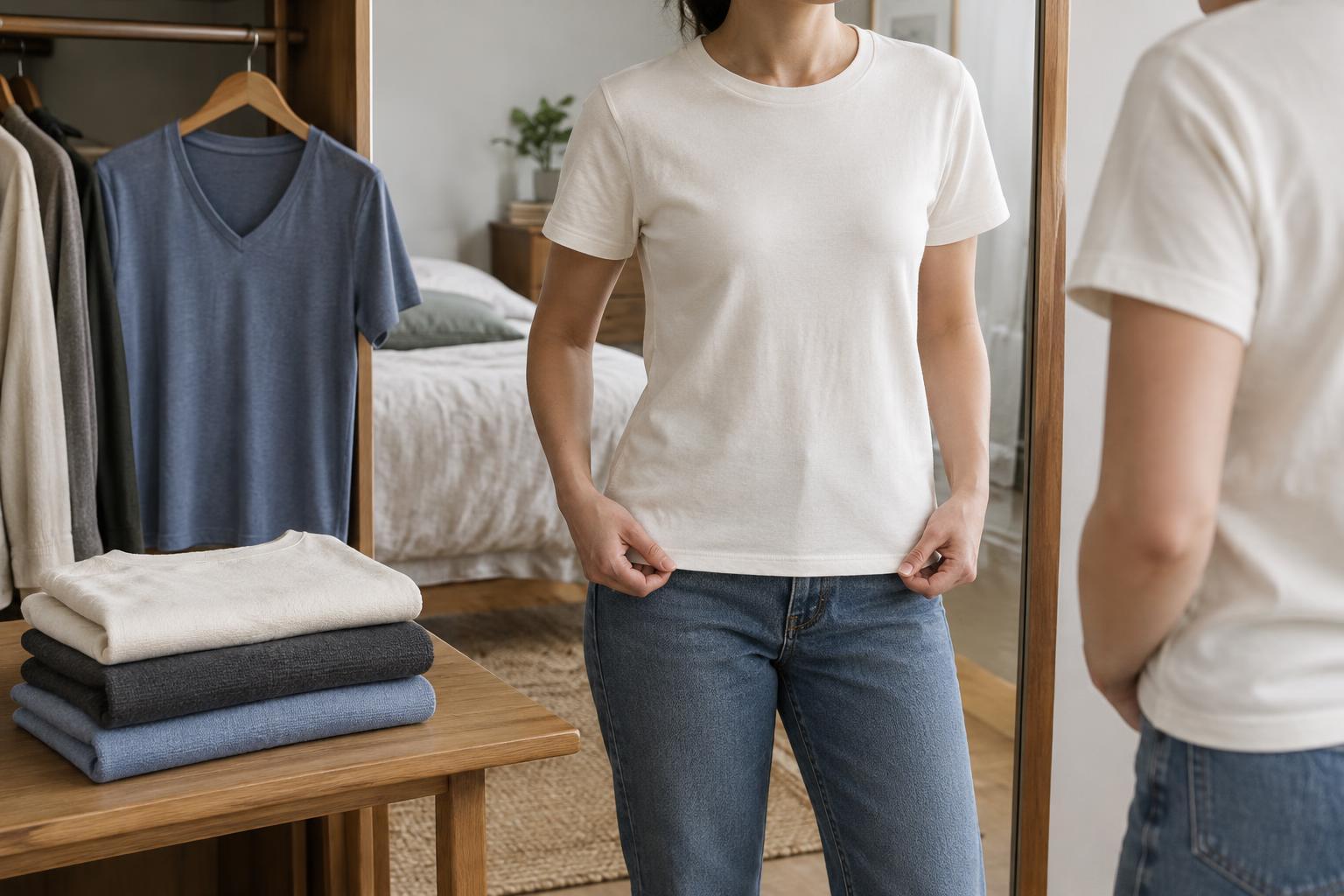
For a classic fit, look at where the shoulder seams sit. Seams near the ends of your shoulders generally create a defined shape; seams that fall farther down give a more relaxed look. Neither is inherently better. Across the chest and back, the fabric should have enough room for you to lift your arms, sit and turn without feeling pulled. Notice whether the shirt twists or rides up as you move.
Length changes how useful a tee feels. Try it both tucked and untucked, even if you expect to wear it only one way. An untucked hem should land where you like it alongside your usual trousers or skirt; a tucked tee needs enough length to stay in place without creating more bulk than you want. Check the sleeves, too. Their width and length can make the same body fit feel noticeably different.
If a T-shirt fits well in the shoulders but not at the waist, try another cut rather than assuming a different size will solve everything. Sizing up changes the neckline, sleeves and length as well as the body width. A quick try-on with a familiar pair of bottoms is often more informative than the size printed on the label.
Choose a neckline for comfort and layering
A crew neck sits relatively high and has a simple, contained shape. It can look neat on its own and is easy to wear under open overshirts or jackets. If you dislike fabric close to your neck, though, pay attention to the opening and the firmness of the neckband. A neckline that feels only slightly restrictive in the fitting room may not become a favourite for a full day of wear.
A V-neck opens up the area at the collar and can leave more space around the neck. The depth varies considerably, so check where it falls when you sit or bend, not just when you stand straight. Scoop and wider round necks offer another option, especially if you prefer a more open shape without the point of a V. For a versatile wardrobe, you do not need one of every style: start with the neckline you consistently enjoy wearing.
Match fabric weight to coverage and drape
Fabric weight influences how a T-shirt hangs. A lighter knit often feels softer and can be comfortable under other layers, but it may show the outline of what is beneath it or cling where you would rather it did not. A heavier knit tends to hold its shape more visibly and may feel substantial on its own. It can also feel too bulky beneath a close-fitting layer. Midweight fabric is a useful option if you want one tee to serve both purposes.
You do not need a technical fabric specification to compare options. Hold the T-shirt up to the light to assess coverage, then put it on and see how it falls. Check it in a natural standing position rather than pulling the fabric smooth. Cotton is common, but fibre content alone will not tell you how a shirt will feel: the knit, finish and construction also affect softness, stretch and drape. If you prefer stretch, notice whether the fabric returns to shape after you gently pull and release it.
Make the final choice with your wardrobe in mind
Look closely at the details that affect repeated wear. Is the neckline sitting flat? Do the side seams hang reasonably straight? Does the hem look even? These checks cannot guarantee how long a T-shirt will last, but they can help you spot a shape you already find distracting. Read the care label as well, particularly if you prefer not to sort out special washing or drying requirements.
For a first purchase, choose a colour that works with several bottoms or layers you own, then wear the tee a few times before buying duplicates. You may discover that the sleeves are ideal but the length is not, or that the fabric feels different after washing. The best everyday T-shirt is not necessarily the most substantial or the most fitted one. It is the one whose fit, neckline and fabric make it easy to get dressed in a way that feels like you.