Start with the hold you need
The best hair accessory is not necessarily the one with the strongest grip. It is the one that holds your intended style with the least fuss and tension. Before choosing one, decide what it needs to do: keep a few strands off your face, secure a low bun, hold a half-up style or gather all your hair. A small clip may be perfect for the first task and frustrating for the last.
Consider how much hair the accessory must contain, as well as its texture and length. Thick or slippery hair can overwhelm a clip that is too small. Fine hair may slide out of a large clip before its teeth make contact. Curly or textured hair may need room within a clip so it is not compressed into a tight bundle. The aim is a secure fit without having to force the accessory closed.
Choose clips for capacity and smooth contact
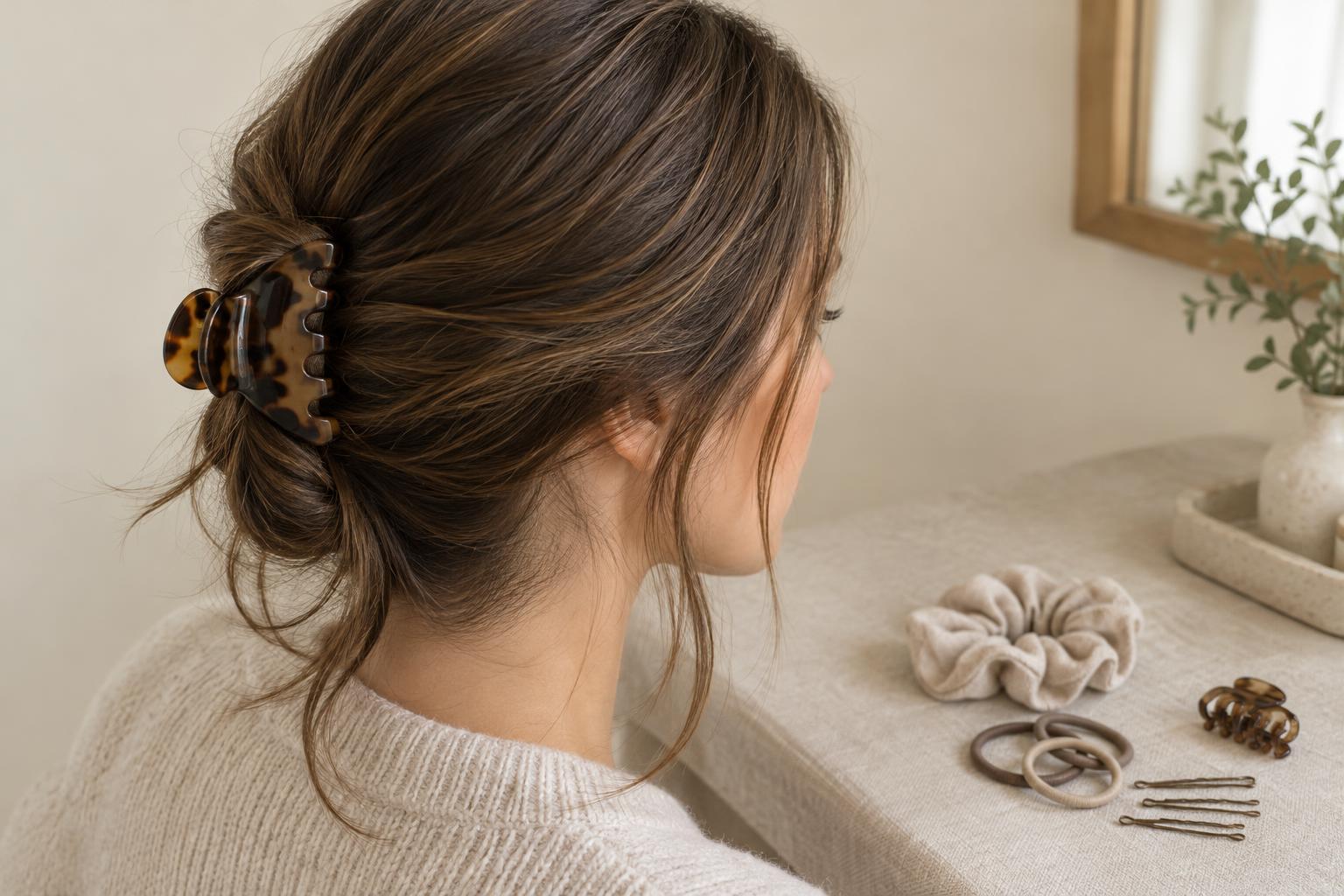
Claw clips work well when their opening comfortably fits the section you want to hold. Check that the teeth meet the hair rather than only each other, and look for smooth edges that will not snag loose strands. If a full twist feels crowded, try a larger clip or use the same clip for a half-up style. Placing it over a loosely twisted section can give it more to grip than placing it over flat, loose hair.
Barrettes and snap clips are useful for smaller sections, but their closures should not pinch the hair against the scalp. A barrette that springs open is often too small for the section; repeatedly clamping it harder is unlikely to improve comfort. For a neat side section, start with less hair and position the clip where it can lie relatively flat. When shopping, open and close a clip a few times to check that its hinge moves smoothly and its edges feel finished.
Use pins to support a style, not squeeze it
Pins are most effective when they anchor one section of hair to another. For a loose bun, insert a pin through a small part of the outer twist, then guide it toward the hair nearer the head. A few pins placed at different points can distribute the hold more comfortably than one pin pushed in tightly. If a pin slides out, changing its angle or gathering a smaller section may help.
Check the tips before use. A pin with a rough end or missing coating is more likely to catch as you insert or remove it. Hair sticks and U-shaped pins can also secure gathered styles, provided the style is loose enough to accommodate them. Whichever type you use, remove it slowly rather than pulling it straight through tangled strands.
Pick ties that gather without digging in
A tie should stretch enough to wrap around the hair without requiring a hard pull. Soft, fabric-covered ties are a practical starting point; a wide tie can spread pressure over a larger area than a narrow elastic. Look for joins that feel smooth, and retire ties that have become stretched, rough or prone to catching. Avoid relying on extra-tight wraps to compensate for a tie that is the wrong size.
Placement matters as much as the tie itself. A high ponytail may need more tension to stay lifted, while a lower ponytail or loose braid can often stay in place with less. If the style pulls when you turn your head, ease it, move it lower or gather a little less hair. For a heavy ponytail, a clip or pins can support part of the style so the tie does not have to do all the work.
Test comfort through the day
A quick test is more useful than judging an accessory by appearance alone. Put it in, move your head normally and notice whether it tugs at one spot, slips or catches nearby strands. If it needs constant adjustment, try a different size or placement before deciding that you need a stronger grip. Comfort can also change over several hours, so a style that feels fine at first may be worth loosening later.
Build a small selection around the styles you actually wear: perhaps one clip for a full twist, a smaller one for front sections, a few smooth pins and a comfortable tie. Keep their hinges, teeth and surfaces free of caught hair, and replace pieces with sharp edges or damaged coatings. An accessory that suits both your hair and your routine makes getting dressed easier—and lets your hairstyle feel like part of the outfit rather than something you have to endure.