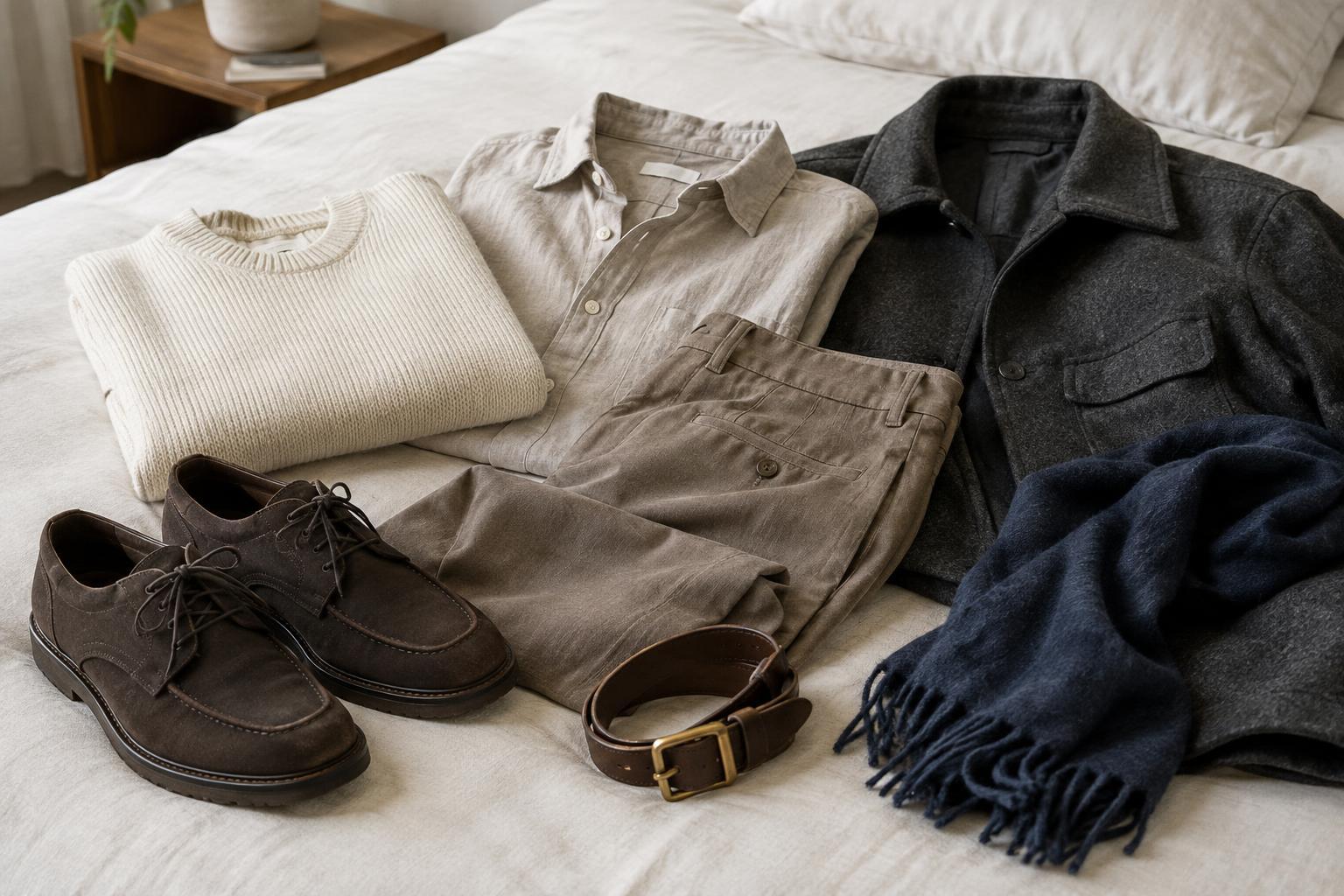
Start with the neutrals you already wear
Neutral colours are often described as colours that go with everything, but no single neutral works equally well in every wardrobe. Black, navy, charcoal, cream, brown, olive and stone can all act as quiet foundations. The most useful ones for you are the colours you enjoy wearing and can repeat across several outfits. Start by looking at the trousers, coats, shoes and bags you reach for most often. Those pieces reveal your existing palette more clearly than a list of supposed wardrobe essentials.
Lay a few favourites next to one another in natural light. Which combinations look intentional, and which seem slightly disconnected? You might notice that your deep navy trousers work with cream, grey and tan, while a particular beige top looks dull beside them. That does not make beige a bad choice; it means that specific shade may not serve your wardrobe well. Use what you observe as a starting point, not as a strict rule.
Compare warmth, depth and contrast
When two neutrals feel awkward together, their undertones may be part of the reason. Some greys have a blue cast, while others lean brown or green. Whites range from bright and crisp to soft and creamy. Browns can look reddish, golden or nearly grey. You do not need to name every undertone precisely. Hold garments together and ask whether their colours seem to share a similar warmth, or whether the difference creates a contrast you actually like.
Depth matters just as much. A dark coat, medium-coloured trousers and a light shirt give an outfit clear separation. Several pieces at almost the same depth can look calm and cohesive, but they may need a change in texture or shape to keep the outfit from feeling flat. Contrast is a preference rather than a requirement: some people like the sharpness of black with white, while others prefer softer pairings such as charcoal with stone.
Build a small palette instead of collecting every neutral
A practical starting palette might include one dark neutral, one light neutral and one or two supporting shades. For example, navy and cream could form the foundation, with soft grey and cognac added through knitwear, shoes or a bag. Alternatively, dark brown and ivory might pair with olive and warm stone. These are examples, not formulas. The point is to give your clothes several easy connections without expecting every item to match every other item.
Think about where each colour will appear. A dark neutral used in trousers and outerwear creates a different wardrobe from one used mainly in small accessories. If you wear the same coat or shoes frequently, make sure their colour works with several of your usual outfits. Before adding a new neutral, picture at least two combinations using pieces you own. If you can only imagine wearing it with one item, it may be an accent rather than a useful foundation.
Let texture and proportion help colours connect
Even closely matched neutrals can look more interesting when their textures differ. A smooth cotton shirt under a chunky knit, or denim beside a soft wool coat, gives the eye something to notice without adding another colour. Texture can also make a colour appear lighter or darker: a glossy black shoe and a matte black trouser, for example, will not necessarily look identical. They do not need to. Treat slight differences as part of the outfit rather than flaws to correct.
Proportion can make an unfamiliar pairing easier to wear. If you are unsure about mixing a cool grey with a warm brown, try one as the main colour and the other as a smaller detail, such as a belt or scarf. Repeating a neutral once elsewhere can also make it feel deliberate: a cream shirt might echo cream in a patterned scarf. These adjustments are useful when colours do not match exactly but still look appealing together.
Test combinations in real outfits
Colour swatches and online images can offer ideas, but your own clothes give you a better test. Put together a few complete outfits, including shoes and outerwear, and look at them in the light where you usually get dressed. Try sitting, walking and adding the layers you would wear on an ordinary day. A pairing that looks good on a hanger may feel different once the whole outfit is on, while an unexpected combination may become a favourite.
Keep note of the combinations you want to repeat. You might discover that your navy works best with off-white rather than bright white, or that your favourite tan shoes tie together several otherwise different outfits. Over time, those observations make shopping and dressing simpler. A neutral palette succeeds when it supports your habits and preferences, not when it follows a perfect chart.