Start with UV protection, not lens colour
Sunglasses are both an accessory and a way to reduce your eyes’ exposure to ultraviolet light. Look for a label stating that the lenses block 99 to 100 percent of UVA and UVB rays, or are marked UV400. Check the label on the particular pair you are buying rather than assuming that a familiar brand, high price or dark tint guarantees protection. If the protection claim is unclear, choose a pair with clearer labelling.
Dark lenses do not necessarily block more UV than light ones. Tint mainly changes how bright the world looks through the glasses. Polarized lenses reduce reflected glare, which can be useful around water, roads or other shiny surfaces, but polarization alone is not a UV-protection claim. A pair can have both features; check for each separately. Mirror finishes, gradients and coloured lenses are style and visibility choices unless the product also states its UV protection.
Check coverage and a secure fit
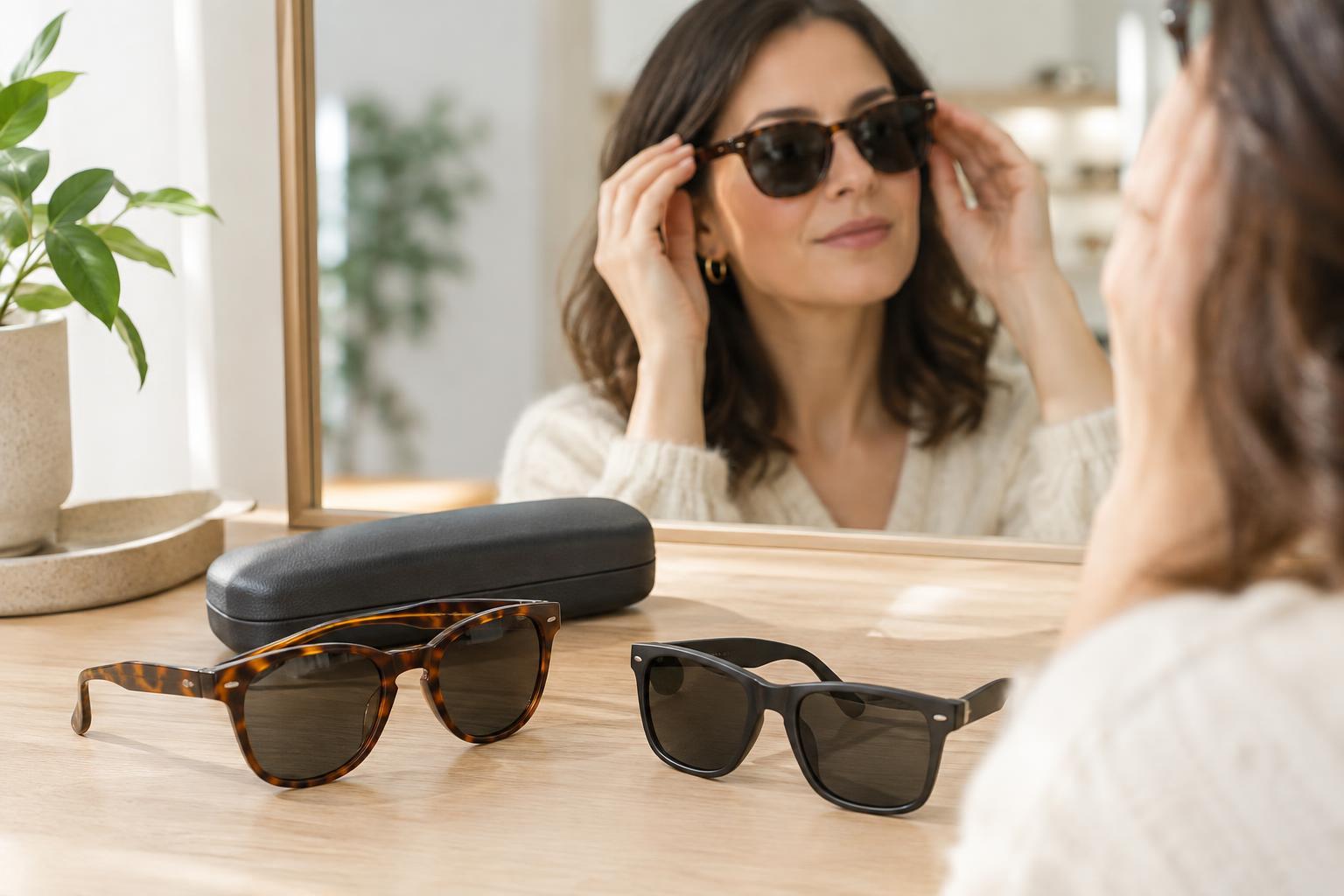
A comfortable pair should sit steadily without pinching the sides of your head or sliding down your nose. The bridge should rest evenly, and the lower rim should not press hard against your cheeks when you smile. Try turning your head, looking down and wearing the glasses for a few minutes if possible. A frame that feels mildly irritating at first may be difficult to wear for a full outing.
Coverage matters as well as comfort. Lenses that cover the eye area generously, or frames that curve slightly around the sides, can help limit light entering from the edges. Very small lenses may look appealing but leave more of the surrounding area exposed. Check whether the temples sit comfortably over your ears and whether the frame works with anything you regularly wear, such as a hat. If you often adjust your sunglasses to keep them in place, try another size or bridge shape.
Choose lenses for the way you use them
Think about your usual surroundings before choosing a tint. Grey lenses generally keep colours looking fairly neutral; brown or amber tints can make the view feel warmer. Gradient lenses are darker at the top and lighter below, which some people find convenient when moving between bright outdoor light and tasks at closer range. Personal comfort varies, so look through the lenses outdoors if a shop allows it and notice whether your view feels clear and comfortable.
Hold the glasses at arm’s length and look through each lens at a straight line, such as the edge of a doorframe. Move the glasses slightly and check for obvious bending or waviness. This simple check cannot verify UV protection, but it may reveal distracting distortion. If you need prescription sunglasses, ask an optical professional about suitable lens and frame options rather than relying on a frame that only looks right.
Find a shape that works with your wardrobe
Style rules based on face shape can be a starting point, but they are not requirements. Instead, compare a few frames and notice the overall balance: the width of the frame against your face, the height of the lenses and how prominent the top edge looks near your brows. A narrow metal frame may feel understated, while a thick acetate frame can become the focal point of an outfit. Choose the effect you enjoy wearing, not simply the shape a guide says you should buy.
For a versatile first pair, consider a frame colour that connects with clothes and accessories you already use. Black can create contrast, tortoiseshell can add a warmer pattern, and brown or translucent frames may feel softer. You do not need to match sunglasses exactly to a bag or belt. Repeating a general tone or level of contrast is often enough to make them feel at home in an outfit.
Make the final choice practical
Before buying, run through three checks: is the UV protection clearly stated, does the frame remain comfortable and secure, and can you picture yourself reaching for it regularly? A striking pair is a good choice if it suits your habits, but a simpler one may be more useful if you want to wear it with many outfits. If two pairs pass those checks, let your preference decide.
Once you have a pair you like, keep it in a case when it is not in use. Clean the lenses with a suitable cloth rather than a rough sleeve, and avoid leaving the frame where it may be crushed or exposed to excessive heat. These small habits help preserve the fit and clarity that made the sunglasses worth choosing in the first place.