Start with a clear shape
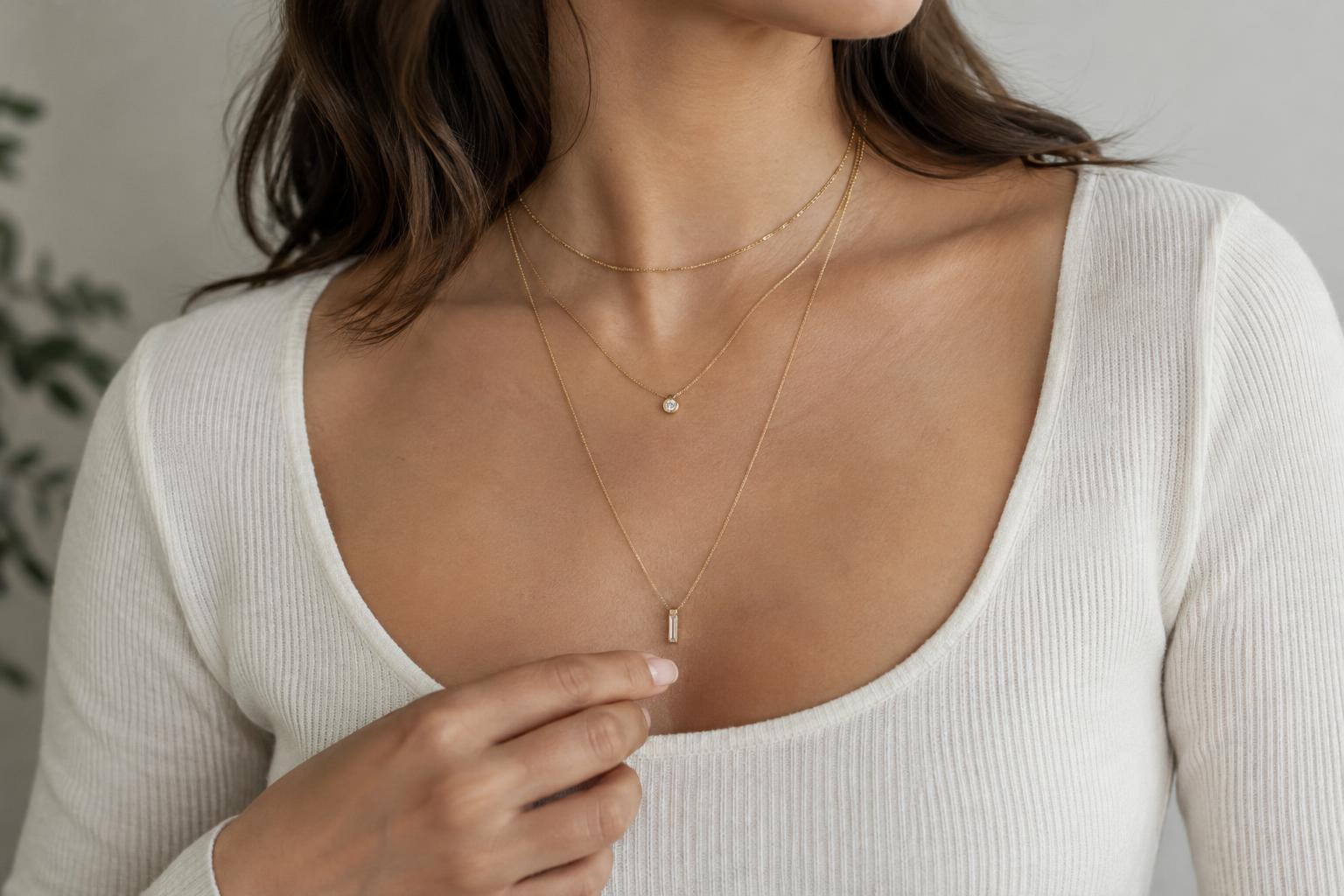
Layered necklaces work best when each piece has a visible role. Rather than putting on several favourites at once, choose one necklace to anchor the look. It might be a short chain that sits close to the neck, a pendant that draws the eye, or a slightly heavier piece that adds texture. Then add one or two necklaces that support it without competing for the same space.
Two necklaces are enough for a deliberate layered effect, especially with a simple top. If you want three, try giving each a different position: one close to the neck, one around the collarbone, and one below it. The aim is not a perfect staircase of equal gaps. It is to make the chains and any pendants easy to distinguish when you move, not just when you stand still in front of a mirror.
Leave room between lengths
Necklaces sold at different lengths do not always hang far apart on the body. A pendant adds weight and can pull its chain into a lower point, while a thicker chain may sit higher than a fine one of similar length. Try the pieces on together before deciding whether their spacing works. If two pendants keep meeting, shorten one chain, lengthen the other with an extender, or leave one pendant out.
Pay attention to where the chains sit at the sides and back of your neck, too. A very short chain paired with a much longer one can look balanced from the front but feel awkward if their clasps catch. Adjustable chains are useful because you can change the spacing for different tops. Choose a comfortable fit first; a necklace that feels restrictive is unlikely to become easier to wear just because the arrangement looks good.
Work with the neckline, not against it
The top you wear provides the frame for your necklaces. A crew neck often suits a short layer above the fabric and a longer pendant that falls clearly over it. With a V-neck, you can echo the opening with a pendant, but check that it rests either within the open space or below the edge rather than repeatedly catching on it. An open shirt gives you more options: a short chain can sit against the skin while a longer one follows the line of the placket.
For a high neckline, consider wearing all the necklaces over the fabric so their shapes remain visible. If a top has a busy print, ruffles, or decorative buttons, fewer pieces may give each detail more room. There is no rule that every outfit needs a full stack. Sometimes one distinctive necklace and a pair of earrings create a clearer result than three chains competing with the clothing.
Mix textures with a light touch
Using chains of slightly different weights can help the layers read as separate pieces. For example, a fine plain chain, a small pendant, and a modest link chain offer variety without filling every part of the neckline. Mixing finishes can also look intentional when another detail ties the pieces together, such as a shared colour in the pendants or a similar overall scale.
Consider the size of each focal point. Several large pendants in a small area may knock together or obscure one another. If one piece is bold, let the others be quieter. You can use the same approach with other accessories: when the necklace layers are the focus, smaller earrings or a simple scarf-free neckline may keep the outfit feeling balanced. Treat these choices as options rather than rules; your preferred level of detail matters most.
Reduce tangles during wear and storage
Fine chains are more likely to wrap around one another when they hang at nearly the same length or when pendants swing together. More space between layers helps, as does pairing a delicate chain with a sturdier style instead of stacking several very fine chains. A necklace-layering clasp can keep multiple clasps together at the back, although it may not prevent chains from crossing at the front. If a combination needs constant untwisting, changing one piece is usually simpler than repeatedly adjusting the whole stack.
Before leaving home, turn your head, sit down, and move your shoulders to see whether the layers stay comfortable. Also check that clasps are closed and that no chain is catching on a collar or loose knit. At the end of the day, separate the necklaces rather than dropping them together into a jewellery dish. Hanging them individually or placing each in its own compartment makes the next outfit quicker to assemble and helps keep delicate chains from knotting.