Start with how you want to wear it
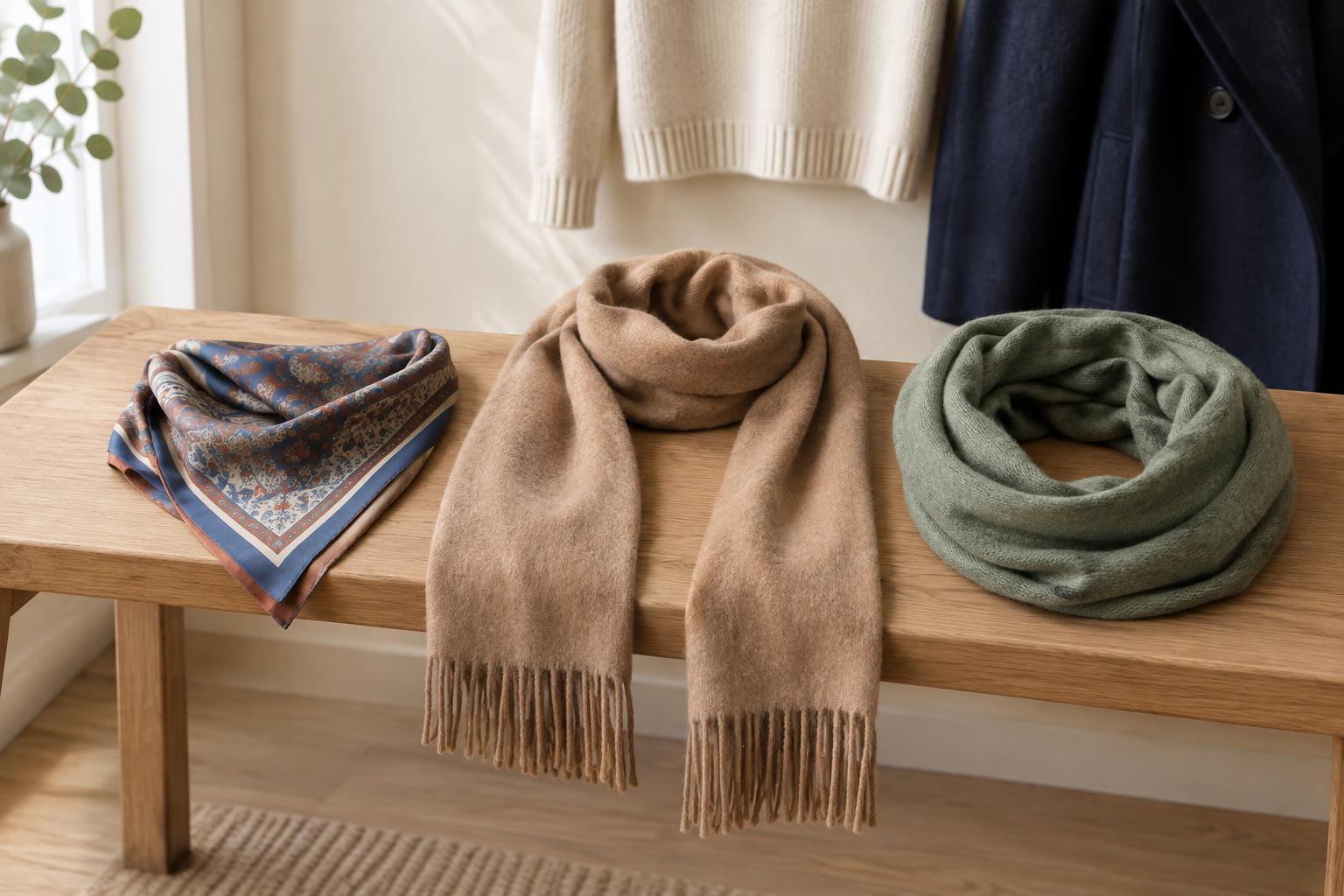
Before choosing a print or colour, picture what you want a scarf to do. Is it a light accent near your face, an extra layer around your neck, or something you can put on quickly as you leave? Shape affects all three. A square scarf folds into a compact band or triangle. A rectangular scarf gives you length to drape and wrap. An infinity scarf is a closed loop that needs no knot.
Your coat and neckline matter, too. A bulky scarf may compete with a high collar, while a small one can sit neatly inside a jacket. If you often carry a bag, consider whether loose ends will get in your way. There is no most-versatile shape for everyone; the useful choice is the one that works with your clothes and the amount of adjusting you enjoy.
Square scarves: compact and adaptable
A square scarf is a good choice when you want a noticeable accent without a lot of fabric hanging down. Fold it diagonally for a triangle that fills an open neckline, or fold it into a narrow band and tie a small knot at the neck. A smaller square can also be tied to a bag handle. A larger square offers more coverage, but its folds may need a little arranging.
Squares suit days when you want colour or pattern close to your face. They can be especially handy with simple tops, shirts and jackets, where the scarf becomes the focal point. If you prefer a low-maintenance fit, pay attention to the fabric: a slippery scarf may need readjusting, while one with more texture may hold a fold more readily. Try tying it at home to see whether the knot feels comfortable and stays where you want it.
Rectangular scarves: room to drape and wrap
A rectangular scarf offers the widest range of familiar wearing options. Let the ends hang loose, wrap it once around your neck, or fold it lengthwise and pass the ends through the loop. Those choices let you change the look without changing scarves. A long rectangle can add warmth when wrapped, while a lightweight one can hang open as a soft vertical line over a top or coat.
Length and width make a difference. A broad, thick rectangle may feel crowded under a fitted coat, and very long ends can be inconvenient if you move around a lot. A narrower or lighter scarf is often easier to tuck in. If you are choosing one in person, try your usual knot while wearing a coat or jacket similar to yours. Check that the ends fall at a comfortable point and that the scarf does not bunch up at the collar.
Infinity scarves: a simple loop
An infinity scarf has its ends joined, forming a continuous loop. Depending on its size, you may wear it hanging loose or twist it into two loops around your neck. With no ends to tie, it can be an easy option when you want a consistent shape and a quick way to get dressed. It also avoids the loose tails that some people find awkward with bags or outerwear.
The trade-off is less flexibility. You cannot shorten an infinity scarf with a knot or spread its ends across your shoulders in the same way as a rectangle. A close-fitting loop may feel snug, while an oversized one can create more volume than you want. Check whether it slips over your head comfortably, where it sits when doubled and how it looks with your most-worn coat.
Make the final choice about your routine
If you like a small finishing detail, start with a square. If you want to experiment with drapes and different levels of coverage, try a rectangle. If speed and a tidy, repeatable shape matter most, an infinity scarf may suit you. These are starting points rather than rules: fabric, size and the way you tie a scarf can change how any shape feels.
For a scarf you will reach for often, choose a colour that works with several of your regular coats or tops. Think about care as well as appearance; check the garment label so cleaning it fits your routine. Finally, wear the scarf for a few minutes at home rather than judging it only in a mirror. The best everyday shape lets you move comfortably and feels easy to put on again tomorrow.