Start with the scarf and the neckline
A rectangular scarf is easy to use because its long shape gives you room to drape, wrap or loop it. You do not need a precise fold or a complicated knot. Before you begin, hold the scarf by its short ends and let it hang to see how much length you have to work with. If it is very wide, fold it lengthwise once or twice for a neater shape.
The fabric matters as much as the length. A lightweight scarf can sit comfortably inside an open jacket, while a thick scarf may work better over a coat. Think about your neckline, too: a crew neck leaves a simple background for a scarf, whereas a shirt collar or hood adds volume. If the result feels crowded, loosen the scarf or choose the least bulky tie.
1. The loose drape
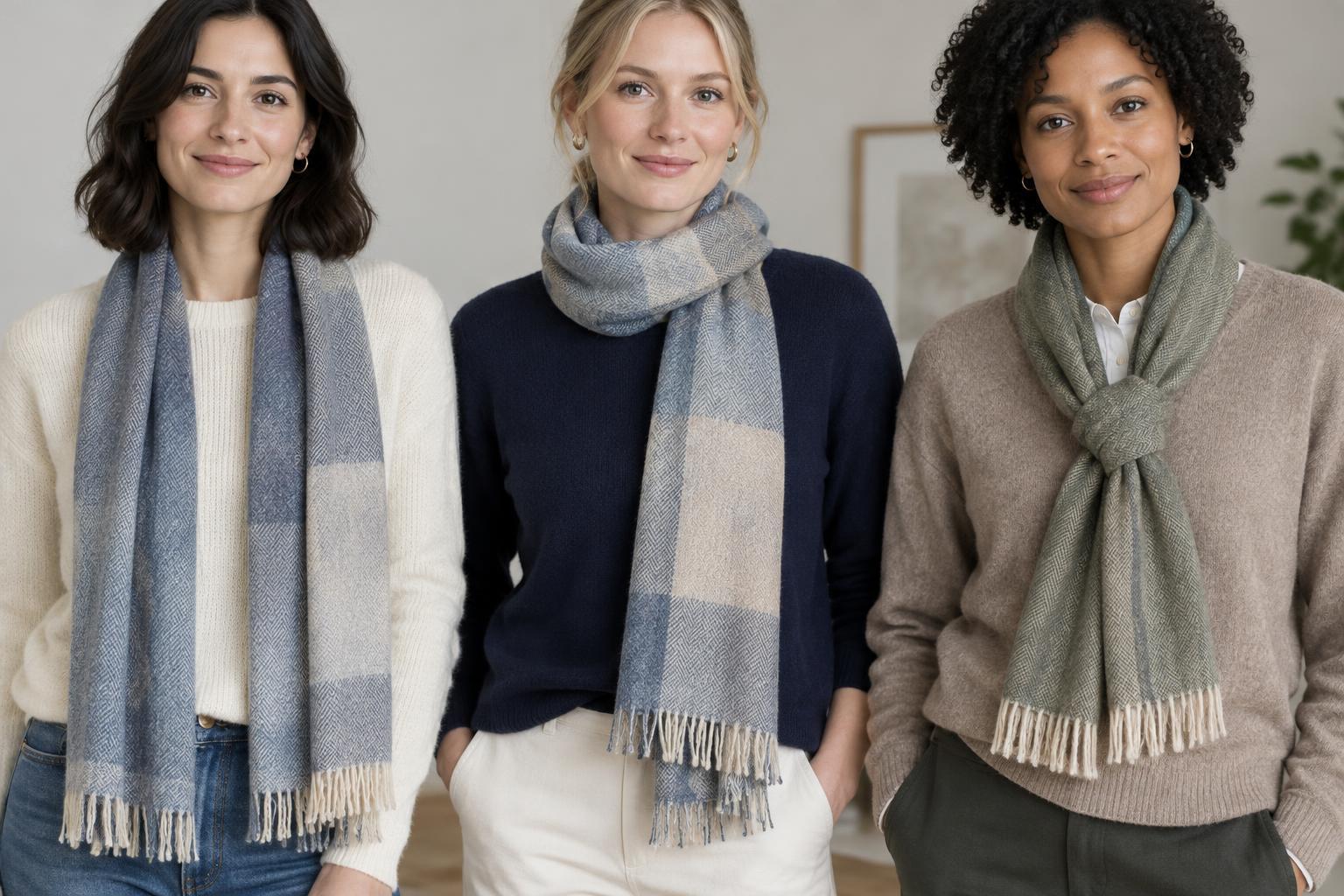
For the quickest option, place the middle of the scarf behind your neck and bring both ends forward. Let them hang without tying them. Adjust the fabric at the back of your neck so it lies comfortably, then decide whether to leave the ends even or pull one slightly longer. That small change can make the drape feel less formal.
This method shows the scarf’s colour or pattern clearly and adds a long line to an outfit. It is useful when you want an accessory rather than a close wrap around your neck. Try it over a plain top, a cardigan or an open coat. If the ends move around too much, tuck them loosely under your jacket or choose one of the more secure methods below.
2. The once-around wrap
Place the scarf behind your neck with one end noticeably longer than the other. Take the long end across the front of your neck, around the back, and forward again. Let both ends hang, then ease the wrap away from your throat until it feels comfortable. You can spread the fabric across your chest or gather it into a narrower band.
The once-around wrap adds softness around the neckline while keeping some length visible. It is especially handy with a medium-length scarf that does not leave enough fabric for a large knot. For a relaxed finish, allow the ends to sit at different heights. For a tidier finish, adjust them to similar lengths. The wrap should stay loose enough that you can turn your head freely and remove the scarf without tugging.
3. The folded loop
Fold the scarf in half lengthwise, bringing the two short ends together. Lay the folded scarf around the back of your neck, with the loop on one side and the two loose ends on the other. Pull both ends through the loop. Then gently widen or tighten the loop until the scarf sits where you want it.
This is a practical choice when you want the ends held in place without making a knot. It tends to work best with a scarf long enough to fold in half and still reach comfortably around your neck. Thick fabric can make the loop feel bulky, so try the method with a thinner scarf first. For a softer look, pull a little fabric out of the loop rather than tightening it close to your collar.
Make each tie your own
Once you know the three basic shapes, small adjustments do most of the styling work. Turn a patterned scarf so the part you like is visible near your face. If your outfit already has several colours, repeat one of them in the scarf for a sense of connection. With a simple outfit, a contrasting scarf can provide the main accent. There is no need to match every accessory exactly.
Comfort is the best final check. Move your shoulders, sit down and see whether the scarf stays where you want it. A tie that looks good but needs constant fixing is probably too loose, too bulky or not suited to that particular scarf. Try another of the three methods rather than forcing it. The easiest way to find a favourite is to wear each tie with clothes you already reach for.